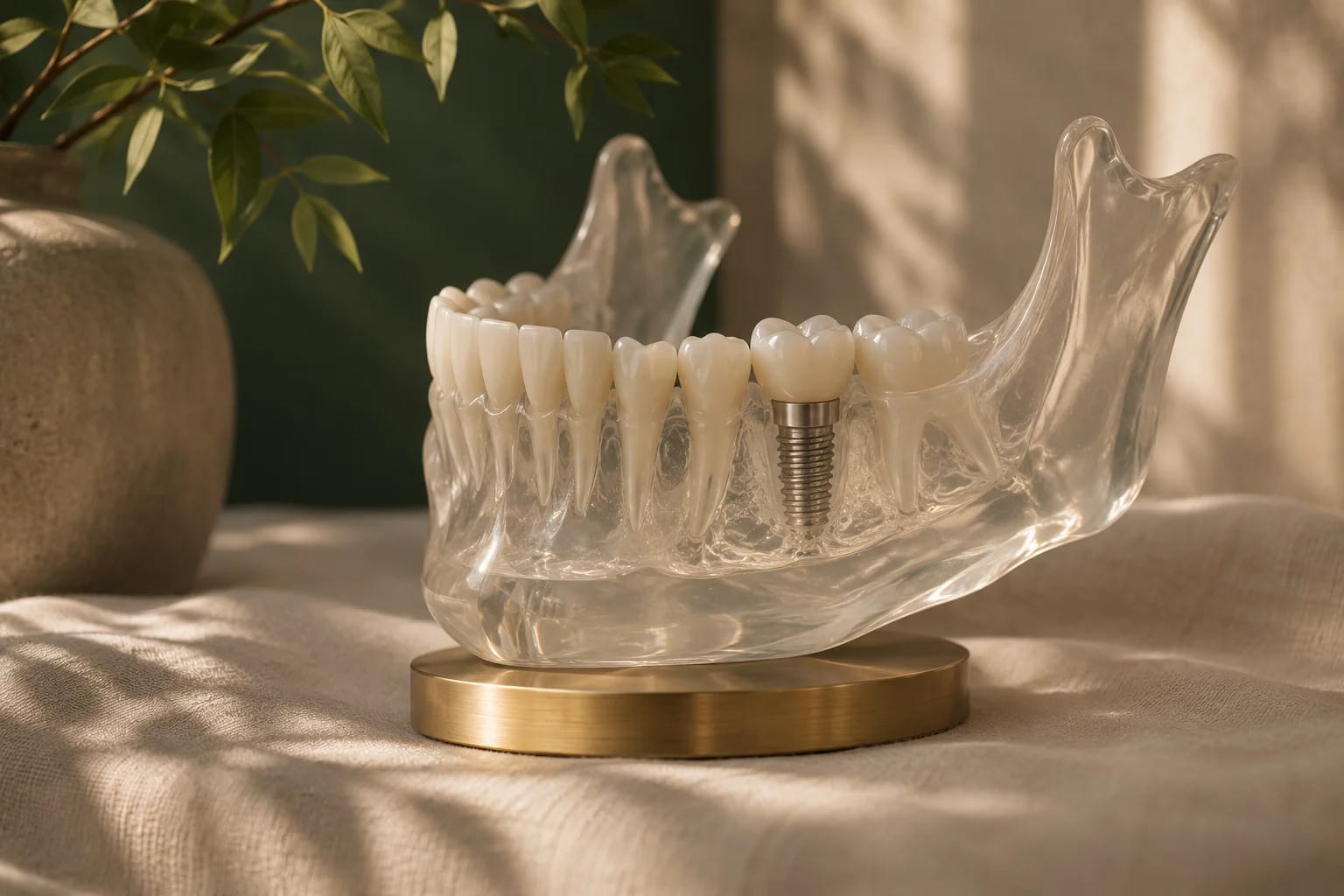
What is All-on-4 and All-on-6?
A fixed full arch of teeth on 4 or 6 implants: who it may suit, how it differs from removable dentures and how treatment works step by step.
Many people who have lost all the teeth in one or both jaws wear removable dentures. For some, they work well. For others, the denture moves, presses on the gums or makes eating and speaking feel uncertain. For them, All-on-4 or All-on-6 treatment may be worth considering.
What the name means
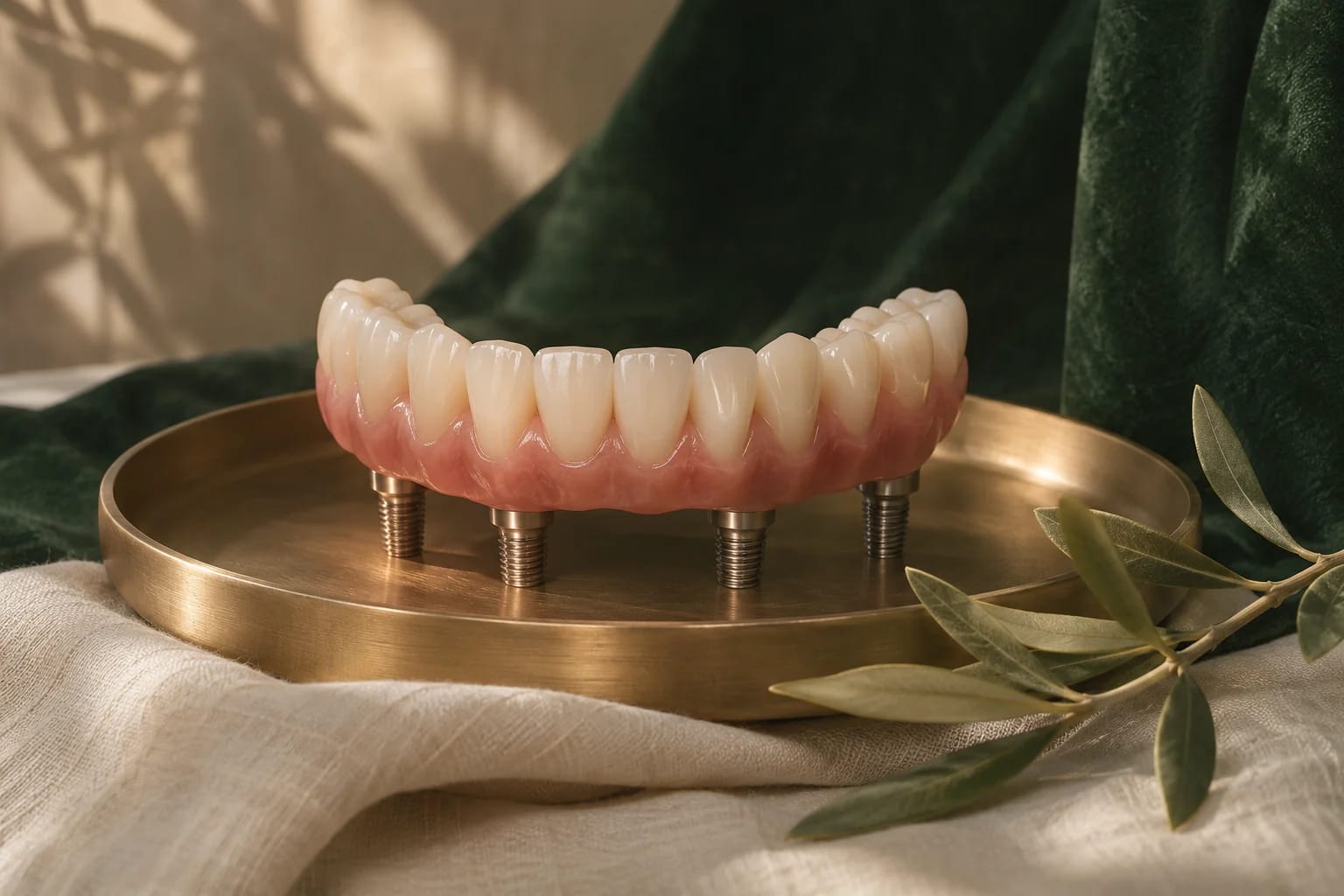
"All-on-4" means that all the teeth in one jaw are replaced by a single fixed bridge held by four implants. All-on-6 follows the same principle with six implants.
The key point is that you don't need an implant for every missing tooth. A few carefully positioned implants can be enough to hold a complete arch securely.
How it differs from a removable denture
The fixed arch is screwed to the implants by your dentist. You don't take it out at night, it doesn't shift when you eat, and you don't need denture adhesive.
An upper fixed arch usually leaves the palate uncovered. Many people appreciate this: they can taste food and feel its temperature better, and speech may feel more natural.
It is worth knowing that fixed teeth still need careful cleaning. You clean them in your mouth, much like natural teeth, and come back for regular check-ups. If needed, your dentist can remove the arch at these visits for a thorough professional clean.
Four implants or six?
The principle is the same; the difference is the number of implants. Which is better for you depends mainly on the amount and quality of your jawbone and on the forces the teeth will need to bear.
This can't be decided from a photo. At the practice we take a 3D scan of your jaw on site, which shows where implants of what size can be placed safely. Based on this, we recommend four or six.
Who might it suit?
All-on-4 or All-on-6 may be an option if:
- you have lost all your teeth in one or both jaws;
- your remaining teeth can no longer be saved;
- your removable denture moves, presses on the gums or bothers you;
- it matters to you not to have to take your teeth out.
We always take your general health into account. Uncontrolled diabetes, heavy smoking or certain medicines can affect healing. We discuss these openly at the consultation and, where appropriate, suggest other options. Please bring a list of your medication.
How treatment works
We always tailor the details to you, but the main steps are usually these:
1. Assessment and 3D scan. We examine your mouth, talk about your health and take a 3D CBCT scan on site.
2. Planning. We plan the implant positions and the shape of the new teeth. You receive a written, itemised treatment plan with the steps and timings.
3. Placement. Any teeth that can't be saved are removed and the implants are placed, under local anaesthetic.
4. Temporary teeth. If the bone allows, you may receive a fixed temporary arch within a short time. If not, we arrange another temporary solution for the healing period.
5. Healing. The implants need time to bond with the bone, generally a few months. We check progress at follow-up visits.
6. Final teeth. Once healed, your final arch is made. Its shape, shade and bite are matched to your face, and we ask for your opinion at the try-in stages.
Who carries out the treatment
All-on treatment involves two specialities. The surgical part – placing the implants – is carried out by Dr Olivér Muskát, our implantologist and oral surgeon. Dr Babett Kenyeres, who focuses on prosthetic and aesthetic dentistry, plans and creates the teeth. Both stages are planned together from the start.
What to expect afterwards
Some swelling and tenderness are common in the first days. Cold compresses, soft food and following our aftercare advice usually help. Avoiding smoking is especially important early on.
In the long run, regular check-ups and careful cleaning at home matter most, so that your implants and new teeth can serve you for a long time.
Is it right for you?
If you would like to find out whether All-on-4 or All-on-6 could work in your case, request a consultation. After the examination you can take your time to consider your options.
If you are travelling from further away, our page for patients from abroad explains how we plan around fewer trips.
Read more: All-on-4 and All-on-6 · Dental implants · Dentures